
Real Coins vs. Bitcoin: Two Paths to Building a Collection That Lasts
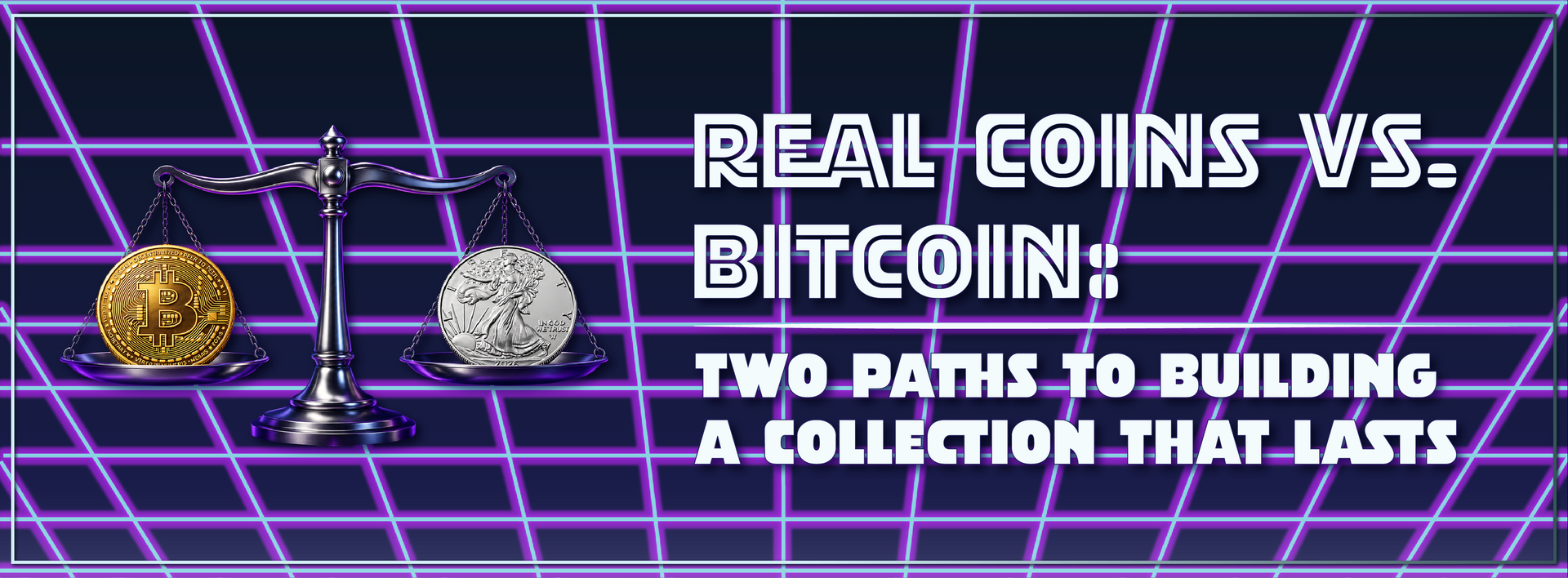
There is something different about owning something truly scarce.
Collectors know that feeling well. It may come from holding a 19th-century silver dollar that survived generations of circulation, estate sales, coin shops, bank bags, albums, and auctions before ending up in your hand. It may come from finding a low-population modern coin in a perfect grade, knowing that thousands of examples may exist, but only a small number reached that level of preservation. It may come from acquiring a gold coin whose value is tied not only to metal content, but also to design, condition, history, and collector demand.
That is the world coin collectors understand. It is physical, historical, and deeply personal. A great coin has weight. It has surfaces. It has flaws, beauty, provenance, and a story. It can be displayed, passed across a table, locked in a safe, graded by a third party, photographed for an auction listing, or handed to a grandchild with a story attached.
Bitcoin lives in a completely different world. It has no weight, no strike, no mintmark, no toning, no slab, and no obverse or reverse. It cannot be held in the traditional sense. Its ownership is digital, its verification happens on a public network, and its scarcity is enforced by code rather than by mintages, survival rates, or the slow disappearance of physical objects.
At first glance, rare coins and Bitcoin seem so different that comparing them almost feels forced. One belongs to history. The other belongs to technology. One is collected in albums, vaults, registry sets, and certified holders. The other is secured through private keys, wallets, exchanges, and blockchain records.
Yet collectors are increasingly studying both because the deeper questions overlap more than the objects themselves. What makes something scarce? How is ownership verified? Who controls the supply? What gives people confidence in authenticity? How is value preserved? How is it transferred? How does a collector protect it, understand it, and eventually pass it on?
Those are not just Bitcoin questions. Those are collector questions.
Rare coins and Bitcoin are not the same thing, and they should not be treated as interchangeable. Physical coins offer tangible history in a way Bitcoin never can. Bitcoin offers digital scarcity in a way physical coins never could. Each has strengths, limitations, risks, and emotional qualities that deserve to be understood on their own terms.
The point of this comparison is not to declare a winner. The point is to help collectors understand why both worlds attract people who think seriously about scarcity, ownership, and long-term value.
Two Very Different Stories of Scarcity
A rare coin begins with something physical. It may have been struck by the United States Mint, circulated through real commerce, saved by a collector, lost in a drawer, cleaned by someone who should have known better, or preserved in remarkable condition against the odds. Its story is tied to metal, history, design, and survival.
A Morgan Silver Dollar can point us back to the American West, the Comstock Lode, expanding industry, and a different monetary age. A Saint-Gaudens Double Eagle reflects one of the most celebrated designs in American coinage. Even modern issues can capture moments in national memory, artistic trends, minting technology, and collector behavior.
Bitcoin begins with a different kind of story. It was introduced in 2009 as a peer-to-peer digital money system, designed to allow value to move without relying on a central bank or traditional financial institution. Its major innovation was not that it was digital. Plenty of things were digital before Bitcoin. Its innovation was that it created a digital asset with a fixed supply and a public verification system that prevents the same unit from being copied and spent twice.
That is why Bitcoin is often discussed as “digital scarcity.” The phrase can sound like marketing until it is understood properly. Most digital things are abundant because they can be copied endlessly. Bitcoin is different because the network keeps a public record of ownership and supply. People can copy a picture of a Bitcoin logo all day long, but they cannot create additional Bitcoin outside the rules of the network.
Coin collectors do not need to become computer scientists to understand the basic point. Bitcoin’s supply is limited to 21 million coins. Ownership is tracked on a public ledger called the blockchain. Control depends on cryptographic keys. Transactions can be verified by the network rather than approved by a single central authority.
That gives Bitcoin some qualities collectors recognize immediately: limited supply, verifiable ownership, and a system for distinguishing genuine ownership from imitation. But recognition is not the same as equivalence. A certified coin and a Bitcoin entry on a ledger are different forms of ownership, and each must be judged by the standards of its own world.
What Physical Coins Do Best
The strongest argument for rare coins is simple: they are real objects tied to real history.
A rare coin is not merely an asset. It is a surviving artifact. It may have passed through commerce during a specific era, been struck during a notable presidency, carried a design that reflected national ideals, or survived in high grade because someone made the unusual choice to preserve it.
The emotional experience of coins matters. Collectors enjoy the look of original surfaces, the sharpness of a strike, the glow of gold, the ring of silver, the hunt for varieties, and the satisfaction of placing a meaningful piece into a collection. A coin can be studied under magnification, compared to population reports, researched through auction archives, and enjoyed simply for what it is.
That physical connection is hard to replace. It is one reason rare coins have endured as a collecting category for generations. They appeal to the eye, the hand, and the imagination. The best collections are often part museum, part financial holding, part family archive, and part personal achievement.
Physical coins also have an established ecosystem. Collectors can use grading services such as PCGS and NGC, consult auction records, review price guides, attend coin shows, work with reputable dealers, and compare coins in person. None of those systems are perfect, but they give collectors tools for making better decisions.
The coin market has its own risks, of course. Collectors can overpay, misunderstand grading, buy problem coins, chase trends, or purchase from unreliable sellers. Counterfeits exist. Cleaning and damage can dramatically affect value. Market interest can shift over time. Still, the basic framework is familiar and time-tested.
For collectors who value history, artistry, physical ownership, and the experience of holding something that survived across generations, rare coins offer something Bitcoin cannot duplicate.
What Bitcoin Does Differently
Bitcoin’s strongest argument is different. It is not history you can hold. It is a digital asset with a fixed supply, global transferability, public verification, and fractional ownership.
A person does not need to buy one full Bitcoin. Bitcoin can be divided into smaller units called satoshis, which allows people to hold fractional amounts. That makes it different from many rare coins, where access to the best pieces may require large upfront purchases.
Bitcoin also does not require a coin show, dealer inventory, shipping, grading submission, or physical storage vault. It can be transferred digitally, held in different forms of custody, and verified through the network. For people who value portability and digital ownership, that is part of the appeal.
But those strengths come with serious responsibilities. Bitcoin ownership depends on custody. If Bitcoin is held on an exchange, the owner is relying on that platform. If Bitcoin is held in self-custody, the owner must protect private keys. If those keys are lost, stolen, mishandled, or poorly documented, access may be permanently lost.
That is very different from losing a password to an ordinary online account. There may be no simple reset button.
Collectors should understand that custody risk is one of the biggest differences between physical coins and Bitcoin. A rare coin can be stolen, damaged, misplaced, or sold by mistake, but it is still a physical object that can often be identified, insured, recovered, or documented. Bitcoin has a different risk profile. Digital theft, exchange failure, phishing, poor wallet practices, and estate-planning failures can create permanent consequences.
This is why Bitcoin should never be approached casually. A collector who would never buy an expensive raw coin from a stranger in a parking lot should not take Bitcoin advice from a random social media account promising easy money. The same discipline applies. Slow down. Learn the terms. Understand custody. Check sources. Avoid pressure. Be skeptical of anyone who turns urgency into a sales tactic.
Verification: Grading Services vs. Blockchain Records
The comparison becomes especially interesting when looking at verification.
In coins, verification often comes through expert authentication, grading, provenance, and market acceptance. A coin certified by a major grading service carries information that helps buyers understand authenticity and condition. Population reports can help estimate how many examples exist at certain grade levels, although collectors still need to understand that populations can change, resubmissions happen, and market demand varies.
Bitcoin verification works in an entirely different way. The blockchain records transactions publicly, and the network verifies ownership according to its rules. There is no grading service deciding whether a Bitcoin is genuine. The network either recognizes a valid transaction or it does not.
That makes Bitcoin’s verification less subjective than coin grading, but also far less connected to beauty, condition, provenance, and historical romance.
This is a major distinction. Two Bitcoins are interchangeable in a way two rare coins are not. One 1881-S Morgan Dollar in MS65 may be attractive, original, and sharply struck, while another technically similar example may be dull, baggy, or less desirable. Eye appeal matters. Strike matters. Surfaces matter. Story matters. Rare coins are not just units. They are individuals.
Bitcoin is different. One Bitcoin is generally treated the same as another Bitcoin. It does not have eye appeal. It does not have a better strike. It does not become more attractive because it sat in an old cabinet. Its value proposition rests on network acceptance, scarcity, portability, security, liquidity, and belief in the system rather than individual physical character.
For many collectors, that makes coins more satisfying. Coins provide pleasure beyond price. A collector can enjoy a coin during market highs and lows because the object itself has meaning. It can be researched, displayed, compared, and discussed. It can connect a family to a period of history. A great coin is not only something owned; it is something experienced.
Bitcoin’s appeal is less sensory and more conceptual. It attracts people interested in monetary history, digital ownership, fixed supply, decentralization, and long-term technological adoption. Some collectors find that fascinating. Others do not. Both reactions are reasonable.
Value, Risk, and Market Reality
The question of value should be handled carefully.
Rare coins and Bitcoin can both fluctuate, sometimes sharply. Neither should be described as guaranteed, predictable, or safe in a simplistic way. Coin values can be affected by grade, eye appeal, demand, metal prices, auction exposure, economic conditions, collector trends, and the reputation of the seller. Bitcoin can be affected by market sentiment, regulation, liquidity, technology concerns, institutional adoption, custody failures, macroeconomic conditions, and broader risk appetite.
In both worlds, education matters. The collector who understands what they are buying is in a stronger position than the person chasing a headline. This is especially true when enthusiasm is high.
Coin collectors have seen this pattern before. When a market gets hot, ordinary items are sometimes promoted as extraordinary. New buyers overpay. Sellers lean too hard on buzzwords. People confuse scarcity with desirability. Bitcoin and crypto markets have their own version of that same problem, only faster and louder.
That is why the collector mindset is useful. Good collectors are trained to ask uncomfortable questions. Is this truly scarce, or merely advertised that way? Is demand broad and lasting, or temporary and emotional? What are the risks? How do I verify ownership? What happens if I need to sell? How will my family understand this if I am not here to explain it?
That last question may be the most important one for serious collectors.
Custody, Inheritance, and Passing Value On
A coin collection can be poorly planned, but at least heirs can usually see it. They may not know what it is worth, and they may need help from a reputable dealer or appraiser, but the collection exists physically. There may be invoices, slabs, albums, boxes, labels, photographs, insurance schedules, or auction records. With enough effort, the trail can often be reconstructed.
Bitcoin inheritance can be more complicated. If heirs do not know it exists, cannot access the keys, or misunderstand the custody arrangement, the asset may be lost or mishandled. Estate planning for Bitcoin requires careful documentation without exposing private keys to theft. It may require professional guidance, clear instructions, secure storage methods, and trusted family communication.
This is not a small detail. It is one of the most important practical differences between physical and digital ownership.
Tax treatment also matters. Digital asset transactions may create reporting obligations, and rare coin sales can have their own tax considerations as collectibles. CoinCollecting.com should not present tax advice, but collectors should be reminded that buying, selling, trading, or inheriting valuable assets can have tax consequences.
Whether dealing with rare coins, bullion, or Bitcoin, good records are not optional. They are part of responsible ownership.
⭐ Real Coins vs. Bitcoin: A Simple Comparison
A simple side-by-side comparison helps frame the difference without pretending the two are identical.
| Category | Rare Coins | Bitcoin |
|---|---|---|
| Form of Ownership | Physical object | Digital asset |
| Scarcity | Mintages, survival rates, condition rarity, demand | Fixed supply of 21 million, network-enforced |
| Verification | Grading services, authentication, provenance, auction records | Blockchain verification and private-key control |
| Experience | Tangible, historical, visual, personal | Digital, portable, conceptual, network-based |
| Storage | Safes, vaults, insurance, bank boxes, professional storage | Exchanges, software wallets, hardware wallets, self-custody |
| Main Risks | Counterfeits, overgrading, cleaning, theft, market cycles | Volatility, scams, lost keys, exchange failure, regulation |
| Legacy Planning | Physical transfer, appraisals, inventories, dealer guidance | Key access, custody instructions, secure estate documentation |
The best way to understand the relationship between rare coins and Bitcoin is not to force them into competition. They answer different needs. Rare coins preserve history. Bitcoin tests a new form of digital scarcity. Coins reward knowledge of condition, provenance, rarity, and collector taste. Bitcoin rewards understanding of custody, supply mechanics, network trust, and risk management.
Do Collectors Have to Choose?
For some collectors, coins will always be the preferred path. There is no shame in that. A person who collects for beauty, history, artistry, and tangible legacy may find Bitcoin interesting but emotionally unsatisfying. A digital asset cannot replace the experience of holding a coin that has survived a century or more. It cannot replace the excitement of a coin show, the hunt for a variety, or the pride of building a carefully chosen set.
For other collectors, Bitcoin may become part of a broader scarcity philosophy. They may continue collecting rare coins while also studying digital ownership. They may see gold, silver, rare coins, and Bitcoin as different responses to the same basic human concern: how to own something limited in a world where many things can be created, inflated, duplicated, or diluted.
That does not make Bitcoin better than coins. It makes it worth understanding.
There is also a generational element. Younger people who first became interested in Bitcoin may eventually discover rare coins because they want tangible history. Older collectors who built physical collections may study Bitcoin because they want to understand why younger investors talk about it with the same seriousness previous generations reserved for gold.
CoinCollecting.com sits in an interesting place between those audiences. It can help traditional collectors understand digital scarcity while also helping digital-first investors appreciate the depth and discipline of numismatics.
That bridge matters. The future collector may not see physical and digital scarcity as enemies. They may see them as different categories within the same larger conversation about ownership, preservation, and value.
Understanding Is Not the Same as Endorsing
Any collector approaching Bitcoin should remember one thing: understanding is not the same as endorsing.
You can study Bitcoin without buying it. You can respect the innovation without trusting the market. You can own rare coins and ignore Bitcoin entirely. You can own both and understand that each requires a different strategy.
The smartest collectors do not chase everything. They learn first. They compare. They ask better questions. Then they decide what belongs in their own collection, portfolio, or estate plan.
That is the heart of this discussion.
Real coins and Bitcoin are two very different paths. One is physical, historical, and deeply rooted in the tradition of collecting. The other is digital, mathematical, and still being tested in real time. One appeals to the hand and the eye. The other appeals to the mind and the network. One has centuries of collecting culture behind it. The other is still building its place in financial and technological history.
Both revolve around scarcity. Both require education. Both punish carelessness. Both attract hype when markets get emotional. And both remind us that ownership is never just about acquiring something. It is about understanding what you own, why it matters, how it is protected, and what story it may carry forward.
For CoinCollecting.com, this is where the conversation belongs. Not in the noise. Not in the hype. Not in the tired argument that one world must defeat the other. The better question is more useful:
What can collectors learn by studying both?
The answer is simple. We learn that scarcity keeps changing form, but the collector’s instinct remains remarkably consistent. Whether someone is preserving a historic silver dollar, studying a low-population modern coin, stacking precious metals, or trying to understand Bitcoin, the discipline is the same: look closer, verify carefully, think long term, and never confuse excitement with knowledge.
Because collections that last are not built by accident. They are built by people who understand what they own.
Looking Ahead
As interest in Bitcoin continues to grow, so will our coverage. Let us know if you are interested in any of the other topics:

On a scale of 1-5, how would you rate the content of this blog article?