Sunshine Silver IPO: Why Coin Collectors and Silver Stackers Should Watch SSMR
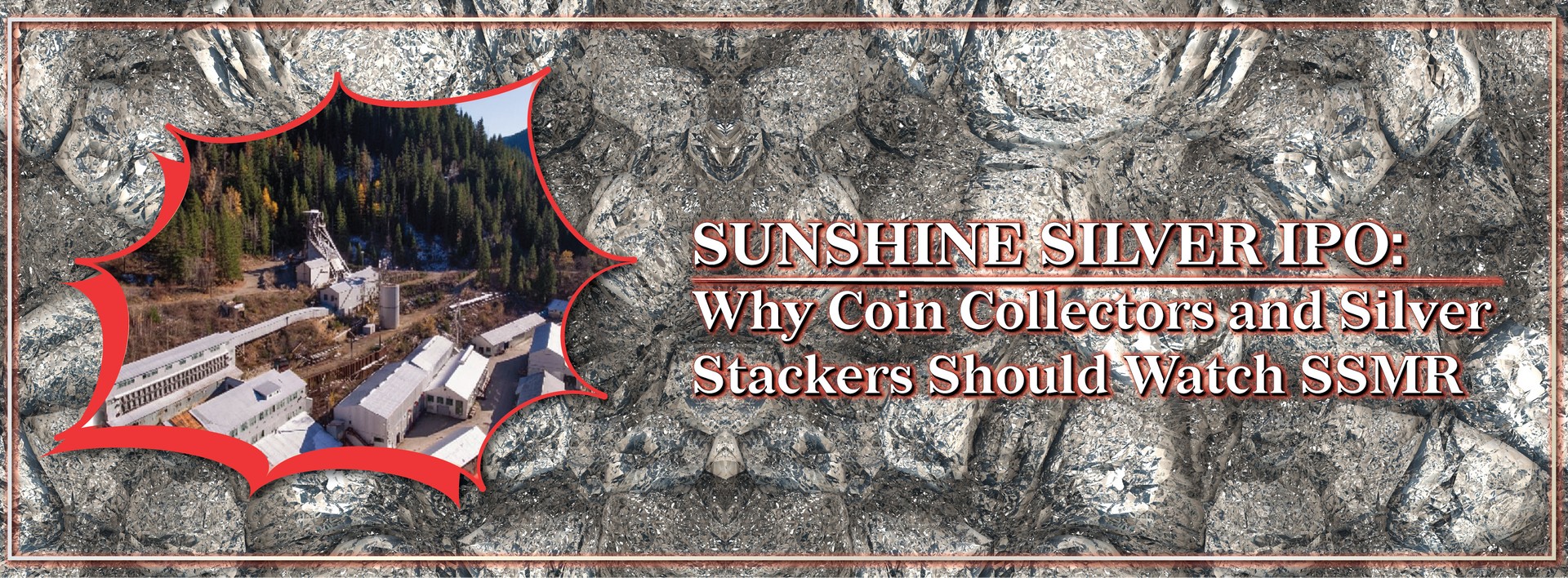
Speaking of investing — since we are in the middle of our investment blog series — there is a silver story moving right now that deserves more than a quick glance.
Sunshine Silver Mining & Refining Company is preparing for an initial public offering tied to a planned New York Stock Exchange listing under the ticker SSMR. The company’s central asset is the historic Sunshine Mine in Idaho’s Silver Valley, one of the most recognized silver-producing regions in American mining history.
For coin collectors and silver stackers, this is not just Wall Street noise.
It is a silver supply story.
It is a domestic mining story.
It is a precious-metals investment story.
And it is the kind of story serious collectors should understand before the headlines get louder.
To be clear from the start: this article is not a recommendation to buy SSMR, or any security. Mining stocks carry real risk. This is an educational breakdown of why the Sunshine Silver IPO matters to people who collect coins, stack bullion, and follow the long-term silver market.
Why the Sunshine Silver IPO Matters Right Now
Collectors tend to think about silver in a very hands-on way. Morgan dollars. Peace dollars. Mercury dimes. Walking Liberty halves. American Silver Eagles. Tubes of bullion rounds. Old 90% silver that has passed through American hands for generations.
But every silver coin and bar starts with a bigger question: where does the metal come from?
That is what makes the Sunshine Silver story so interesting.
Sunshine Silver Mining & Refining Company is tied to the Sunshine Mine, located in Idaho’s Coeur d’Alene Mining District, also known as the Silver Valley. This region is one of the most important silver districts in U.S. history, and the Sunshine Mine has historical production estimated at approximately 365 million ounces of silver.
That is not a small footnote. That is a major American silver legacy.
Now, Sunshine is attempting to bring that story back into focus through a public-market listing. The company has stated plans to restart mining, milling, and refining operations at the Sunshine Complex in 2028, subject to continued development, feasibility work, financing, and execution.
For collectors, this matters because silver is not only a collectible metal. It is also an industrial metal, a monetary metal, and a strategic resource.
The Collector Angle: Silver Is More Than a Spot Price
A coin collector does not look at silver the same way a screen trader does. Collectors see silver as history. We see the worn edge of an old half dollar, the cartwheel luster on a Morgan, the trust behind a government-minted Silver Eagle, and the quiet satisfaction of holding something real.
But the price and availability of silver do not exist in a vacuum. Supply matters. Demand matters. Mining matters. Refining matters.
That is why a potential restart of a large U.S.-based primary silver mine is worth watching.
Most mined silver is not produced from primary silver mines. It often comes as a by-product of mining copper, lead, zinc, or other metals. That means silver supply does not always respond quickly to silver demand. If copper or zinc economics do not justify more mining, silver supply may stay constrained even when silver demand is strong.
A large primary silver story in the United States is different. It puts silver itself closer to the center of the discussion.
What Makes the Sunshine Mine Stand Out
The Sunshine Mine is not being presented as a brand-new discovery with no history behind it. Its story goes back more than a century, and it sits in a region that has long been associated with American silver production.
Sunshine’s materials describe the mine as one of the highest-grade primary silver resources in the world. The company reports:
- Indicated Mineral Resources: approximately 103.9 million ounces of silver
- Inferred Mineral Resources: approximately 159.8 million ounces of silver
Those numbers are attention-grabbing, but they need to be understood carefully. Mineral Resources are not the same thing as Mineral Reserves. Resources do not yet prove economic viability, and Inferred Resources carry a high level of uncertainty.
That distinction matters.
Collectors are used to details. We know the difference between a common date and a key date. Between cleaned and original surfaces. Between a hopeful seller’s claim and a properly graded coin.
The same careful mindset applies here. The Sunshine story is significant, but it is still a development-stage mining story with real execution risk.
Why Domestic Silver Supply Is Back in Focus
Silver demand is no longer driven only by jewelry, coins, bars, and investment products.
Silver is used in solar panels, electronics, electric vehicles, sensors, energy systems, and other technologies. It is valued because it is the best metallic conductor of electricity and because it has properties that are difficult to replace in many applications.
That means collectors are now sharing the silver conversation with industries that are growing quickly.
At the same time, global mined silver supply has faced pressure from declining ore grades, underinvestment, and limited new primary silver projects. The prospectus also highlights that U.S. mined silver production represents only a small portion of global mined supply compared to countries such as Mexico, China, and Peru.
That is why domestic silver production matters.
It is not just about price. It is about supply chains, refining capacity, national priorities, and long-term access to the metal behind the coins and bullion many collectors trust.
The Antimony Angle: A Critical Mineral Twist
The Sunshine story is not only about silver.
The Sunshine Mine historically produced meaningful amounts of antimony, a critical mineral used in defense applications, flame retardants, batteries, semiconductors, and other industrial uses. Sunshine’s materials discuss the potential development of a Sunshine Antimony Plant, which could process antimony-bearing concentrate from the mine and possibly third-party sources.
That adds another layer to the story.
Silver already has strong monetary and industrial relevance. Antimony introduces a critical-minerals angle tied to domestic supply chains and national-security uses.
For collectors, this may seem far from coins at first. But it is part of the same broader trend: metals that once felt niche are now being pulled into much larger conversations about technology, defense, energy, and supply security.
Physical Silver vs. Mining Stocks
This is where collectors need to stay clear-eyed.
Owning physical silver and owning shares of a mining company are not the same thing.
Physical silver gives you direct ownership of the metal. You can hold it. Store it. Trade it. Pass it down. Whether it is a circulated silver quarter or a graded Silver Eagle, the asset itself is tangible.
Mining stocks are different. They can provide leveraged exposure to silver prices, but they also carry company-specific risks. A mining company can face delays, higher costs, permitting problems, financing needs, operational setbacks, commodity-price swings, dilution, or failure to reach production.
That does not make mining equities bad. It makes them different.
Some precious-metals investors use a “barbell” approach: physical silver as the core holding, with selective mining equities for growth potential. Others prefer to stay strictly with coins, rounds, bars, and numismatic assets.
Neither approach is automatically right for everyone.
The important thing is understanding the difference before getting caught up in a headline.
The Risks Are Real
The Sunshine Silver IPO deserves attention, but it also deserves caution.
The company is still working toward a restart. The Sunshine Mine does not currently have Proven or Probable Mineral Reserves. The project depends on additional drilling, feasibility studies, development work, financing, and successful execution.
Mining projects can face delays. Costs can rise. Assumptions can change. Commodity prices can fall. A promising resource can still fail to become a profitable mine.
The preliminary prospectus also includes extensive risk factors, including the fact that the company may not generate operating revenue or achieve profitable operations, may require additional financing, and is dependent on the Sunshine Mine for future operations.
That is why this should not be viewed as a “buy now” story. It is a “pay attention now” story.
Why Coin Collectors Should Care
Coin collectors are already students of metal, scarcity, trust, and history.
We understand that a coin’s value is shaped by more than its face value. Mintages matter. Survival rates matter. Condition matters. Demand matters. The same is true in the broader silver market.
The Sunshine Silver IPO brings several important themes together:
- A legendary American silver mine.
- A potential restart in one of the most historic silver districts in the country.
- A rare primary silver story in a market where most silver is produced as a by-product
- A domestic supply-chain angle.
- A critical-minerals angle through antimony.
- And a public-market investment angle that collectors and stackers may be hearing more about soon.
That combination is why this story deserves a place in the current investing conversation.
The Sunshine Silver IPO is not just a mining headline. It is a silver-market story with real relevance for coin collectors, bullion stackers, and precious-metals investors.
The opportunity is interesting. The history is strong. The domestic supply angle is timely. The risks are also substantial.
At CoinCollecting.com, we believe collectors should understand both sides.
Silver has always been more than a number on a screen. It is history, money, industry, and strategy all pressed into one metal. When a major American silver story starts moving, serious collectors should know what is happening.
This is one to watch.
What do you think? Would you consider a mining stock alongside your physical silver stack, or do you prefer to keep your silver strategy strictly in coins, rounds, and bars?
Disclaimer: This article is for informational and educational purposes only. It is not financial, investment, legal, or tax advice, and it is not an offer to sell or a solicitation to buy any security. Mining stocks, silver, and precious metals investments involve substantial risk, including the possible loss of principal. Mineral Resources are not Mineral Reserves and do not have demonstrated economic viability. Inferred Mineral Resources are highly speculative. Always read the full prospectus and consult qualified professionals before making investment decisions.