Alexander the Great’s Coins: Money That Outlived an Empire
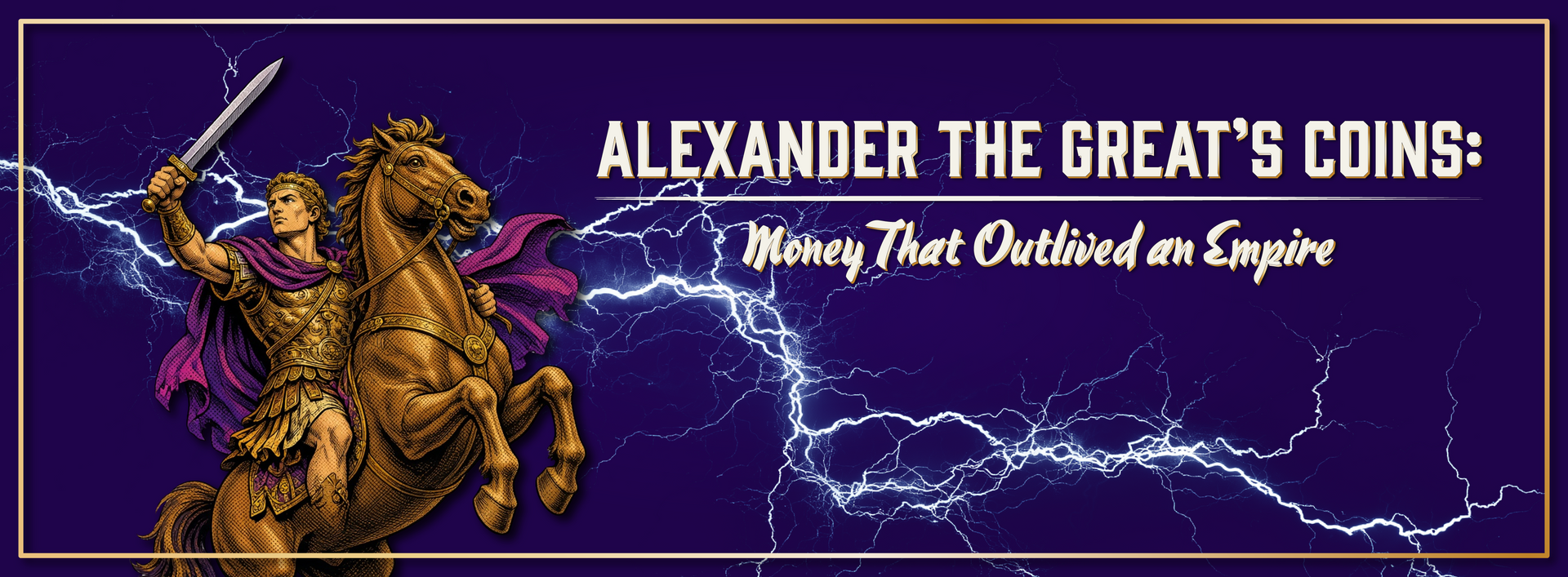
Alexander the Great’s empire fractured after his death, but his money had a longer career. His silver coins helped finance armies, move trade, and spread his name across the ancient world—and rulers continued issuing familiar Alexander types long after he was gone. Today, those coins give collectors something remarkable to study: a monetary legacy told through Greek gods, royal ambition, and small details that can reveal where and when a piece was made. Learning to read them starts with understanding the man whose name they carried.
Alexander’s beginnings: a king, a queen, and a thunderbolt
Before Alexander became a conqueror, stories surrounding his birth were already giving him an impressive introduction. His father, Philip II, ruled Macedon, and his mother, Olympias, was one of Philip’s wives.
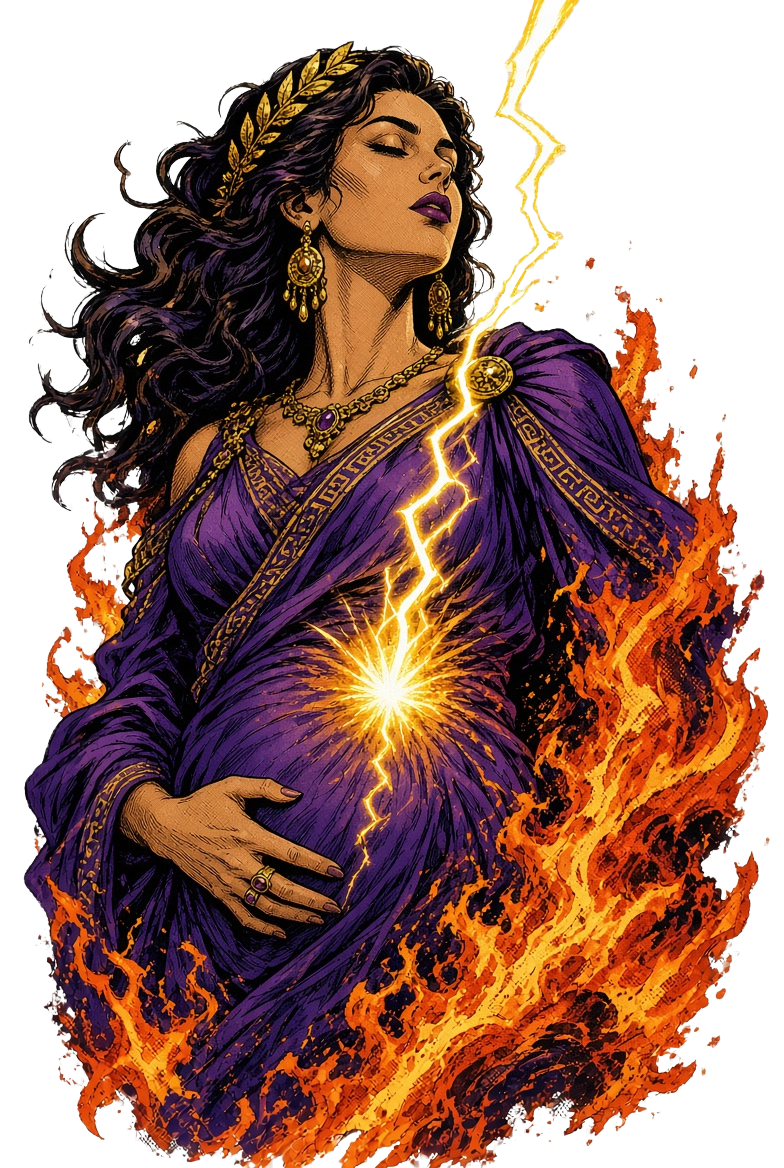
According to Plutarch, Olympias dreamed before her marriage was consummated that a thunderbolt struck her womb, setting off a great fire that spread in every direction before fading away.
Most parents imagine a promising future for their children. This was rather more dramatic.
Plutarch wrote centuries after Alexander’s lifetime, so the dream belongs among the legends surrounding the king, rather than the facts we can verify about his birth. Even so, it reveals how his story was told: Alexander’s arrival was presented as something extraordinary, with a suggestion of divine involvement.
That symbolism matters when we turn to his coins. In Greek mythology, Zeus wielded the thunderbolt, while heroes and ruling families could claim connections to the gods. Alexander’s familiar silver designs drew on that same world, pairing the hero Herakles with an enthroned Zeus. The coins do not illustrate Olympias’s dream, but the legend and the imagery share a language of power, ancestry, and divine authority.
How did Alexander’s coins help run his empire?
Conquering territory was one challenge. Paying for it was another. Soldiers needed wages, supplies had to be purchased, and taxes and tribute had to move through an expanding realm. Alexander’s coinage supported those demands through a more standardized monetary system, with familiar designs produced at mints across his territories.
His conquest of the Persian Empire put enormous reserves of gold and silver at Alexander’s disposal. Using existing mints as well as those established under his rule, he turned that captured wealth into coins to pay soldiers, purchase supplies, and support trade. Precious metal once stored in royal treasuries became money moving through his empire.
Treasure in a palace demonstrated wealth; coins made it available for payment. As that money changed hands, it carried more than purchasing power. Alexander’s name traveled with it, linking everyday transactions to royal authority.
For collectors, this is part of the appeal. These objects belonged to a working financial system, with practical jobs to do long before anyone admired them in a display case.
What is the difference between a drachm and a tetradrachm?
Two silver denominations collectors frequently encounter are the drachm and the tetradrachm. Under the Attic weight standard used for Alexander’s familiar silver coinage, a drachm had a target weight of approximately 4.3 grams. A tetradrachm represented four drachms and weighed approximately 17.2 grams. Surviving specimens vary in weight.
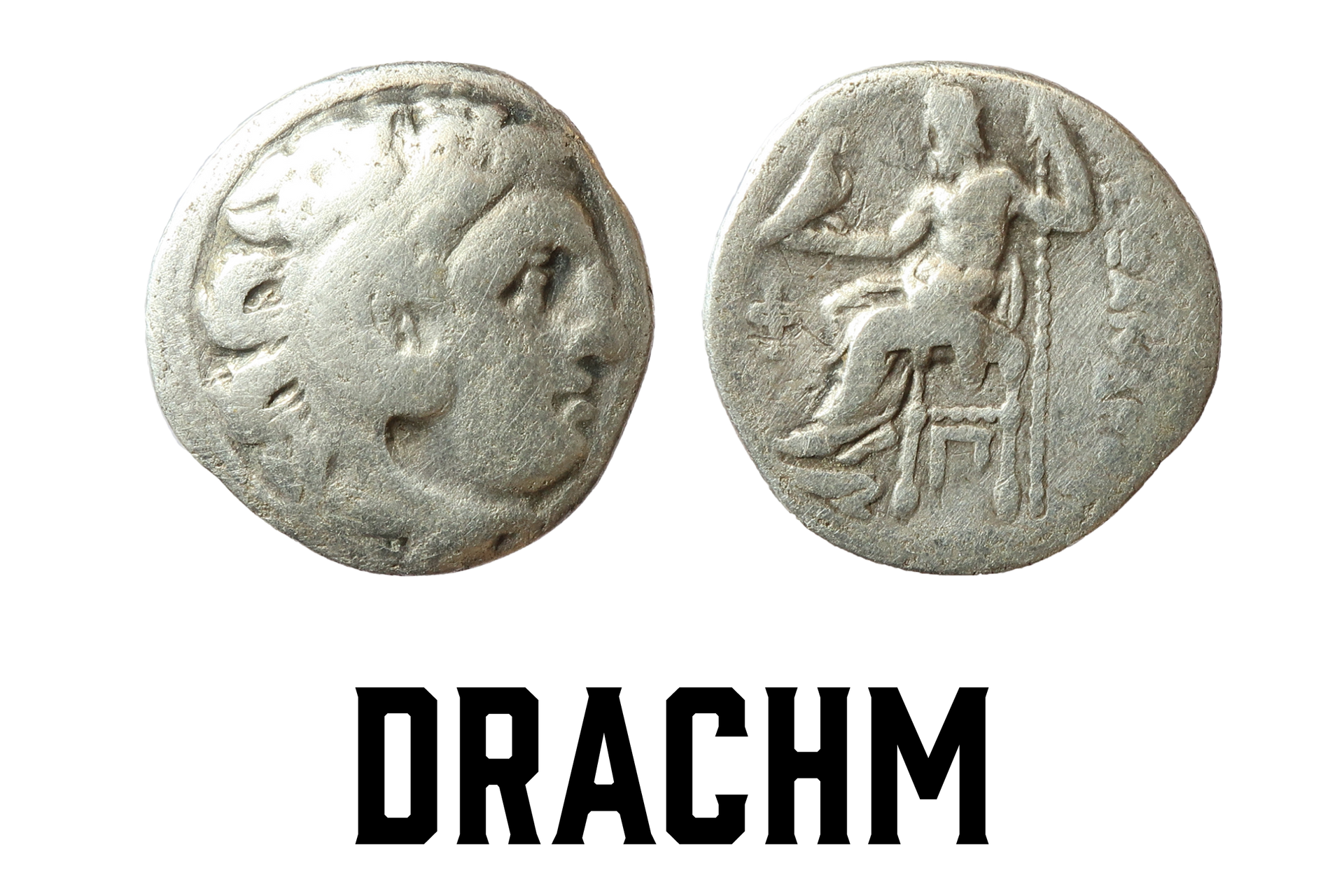
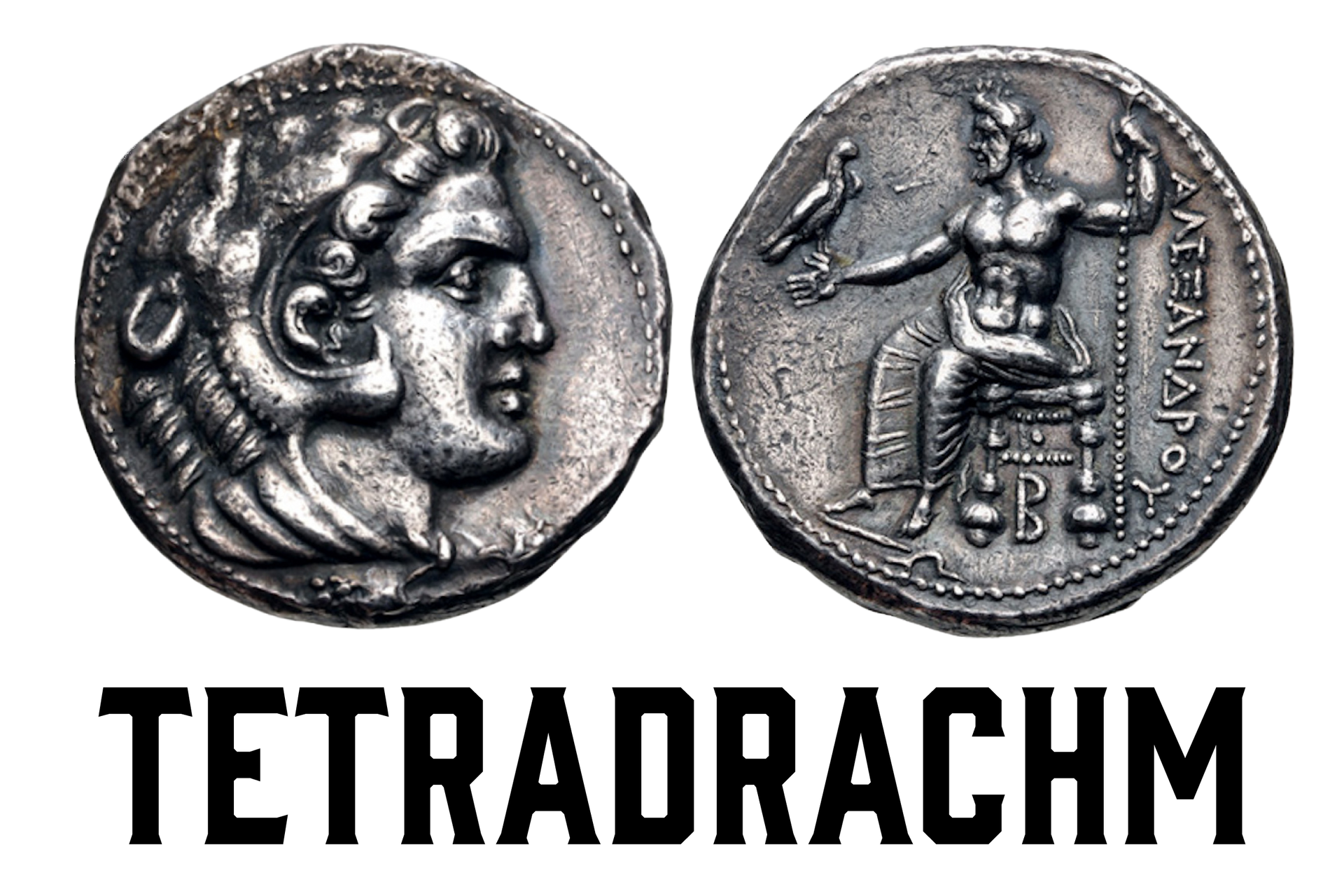
NOTE: Images not shown to scale
Both denominations can feature the same principal designs: Herakles on the obverse, or front, and Zeus on the reverse. The larger tetradrachm gives the engraver more space, making its portrait and reverse details especially satisfying to examine. The smaller drachm carries much of the same imagery in a more compact format.
When browsing descriptions, you will also encounter AR, the numismatic abbreviation for silver. “AR drachm” simply identifies the metal and denomination. Ancient coin catalogs have enough unfamiliar vocabulary without making that one more mysterious than it needs to be.
Who is on Alexander the Great’s silver coins?
The youthful head wearing a lion skin is traditionally identified as Herakles, better known by his Roman name, Hercules. The headdress is the key: look for the lion’s features above the forehead and the skin wrapped around the head and neck. Once you recognize it, the design becomes much easier to read.
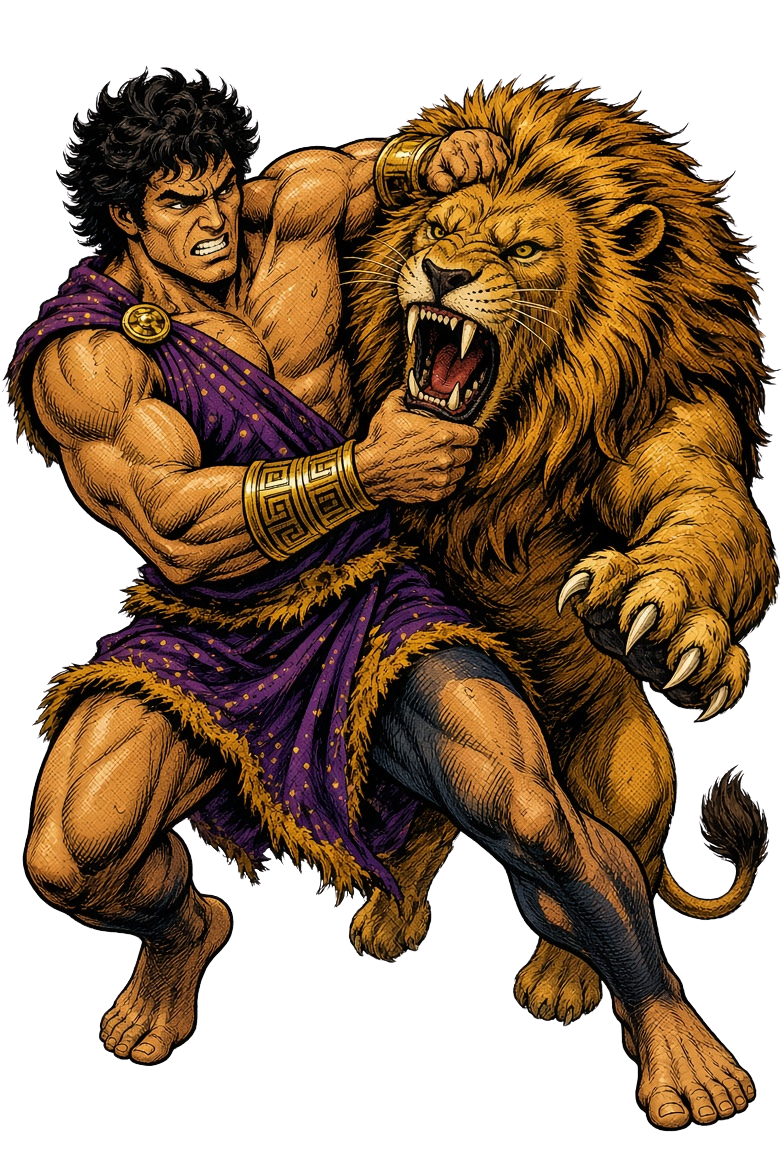
Herakles was an important choice because the Macedonian royal family claimed descent from him. Placing the hero on the coin connected the dynasty with heroic ancestry, giving the portrait a purpose beyond decoration.
The identification also comes with an interesting wrinkle. Scholars have discussed whether some depictions of Herakles incorporated Alexander’s features, creating a visual connection between the hero and the ruler. For collectors describing the standard type, however, “Herakles wearing a lion-skin headdress” remains the sound starting point.
It is a useful reminder that a coin associated with a ruler does not necessarily carry a straightforward portrait of that ruler. On Alexander’s silver, mythology does much of the talking.
What do Zeus and the Greek lettering mean?
On the standard reverse, Zeus sits holding an eagle and a scepter, accompanied by the Greek inscription ΑΛΕΞΑΝΔΡΟΥ, meaning “of Alexander.” The arrangement brings the king’s name and the king of the gods together on the same small piece of silver.
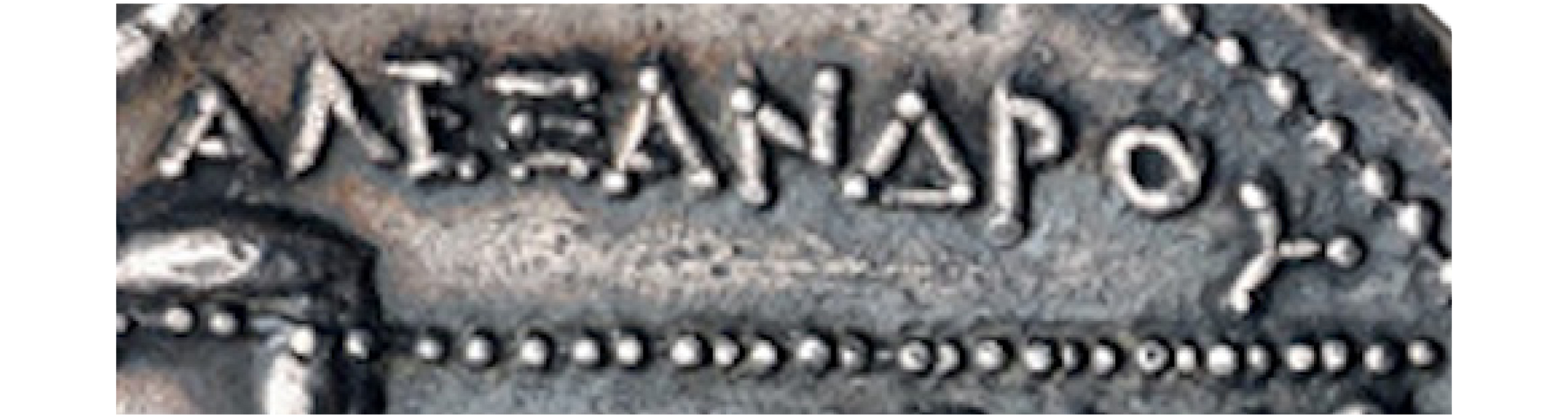
Look beyond those main features and you may find symbols or monograms, which combine letters into a single mark. Specialists use these details, along with other evidence, to distinguish issues and investigate their attribution. Their position can matter: a symbol beside Zeus and a mark beneath his throne are both worth recording.
Museum catalog entries show how specific these descriptions become, identifying details such as a crescent, a lion forepart, or a pentagram. Those little marks can provide a path from “an Alexander coin” to a much more precise identification.
Collectors who already search for mint marks on U.S. coins will recognize the habit. The ancient system is different, but the pleasure of spotting a meaningful detail is much the same.
Why were Alexander’s coins minted after his death?
Alexander died in 323 BC, but the production of coins using his name and designs continued. Successor rulers and independent cities issued familiar Alexander types, often keeping his name even though other authorities controlled the mints. NGC documents the continued use of his designs on gold staters and silver tetradrachms for more than two centuries.
His coinage had become widely accepted, giving those familiar types a useful life beyond the reign that introduced them. Political authority could change while a recognizable form of money continued to serve commerce. Alexander’s name, it seems, had considerable staying power.
This creates an important distinction when collecting:
- Lifetime issue- Struck during Alexander’s lifetime.
- Posthumous issue- Struck after Alexander’s death.
A posthumous issue is not a modern reproduction. It can be an ancient coin produced by a later authority continuing Alexander’s name or designs.
That also explains why a catalog description or grading label might say “Alexander III, 336–323 BC” and then identify the coin as posthumous. The first dates refer to Alexander’s reign, while the additional wording describes the issue. NGC uses such qualifications to distinguish coins made during a ruler’s lifetime from those produced afterward.
Reading the complete attribution matters. The ruler’s name introduces the story; the rest of the description helps place the coin within it.
What should collectors look for in an Alexander coin?
Begin with the attribution: the denomination, the proposed date, the mint if identified, and whether the issue is classified as lifetime or posthumous. Then examine how much of the design is visible and how well it was produced.
Centering describes how the design sits on the metal blank. A coin may have a clear portrait while part of its reverse inscription falls beyond the edge. Strike concerns how successfully the design was impressed into the metal. Weak detail may reflect the minting process rather than wear from circulation—a distinction that can change how you assess a piece.
NGC Ancients considers factors including wear, strike, surfaces, and style. Its grading guidance helps explain why a grade alone cannot describe everything a collector sees. Compare the portrait, lettering, smaller symbols, and condition notes rather than stopping at the abbreviation on a holder.
Available provenance, or documented ownership history, deserves attention as well. So does the seller’s authenticity policy. NGC Ancients states that it encapsulates coins it considers genuine, but its guarantee covers grade rather than authenticity or attribution; it recommends purchasing from sellers who stand behind authenticity.
There is plenty to learn, but you do not need to master ancient Greek before enjoying the process. Recognizing the main designs and understanding the description gives you a practical place to begin.
A legacy collectors can still read
Alexander’s coins bring together history, art, and investigation. Their silver helped finance an expanding empire. Their designs linked royal authority with gods and heroes. Their symbols now give collectors clues to distinguish one issue from another.
The thunderbolt dream preserved by Plutarch offered a dramatic beginning to Alexander’s story. His coinage provides a tangible way to explore what followed—and how much continued after his death. An early posthumous drachm or a later Alexander-type tetradrachm belongs to that longer history, when his empire had fractured but his monetary legacy remained useful.
Start with the lion skin, turn the coin over to Zeus, and take a closer look at the lettering and symbols. More than two thousand years later, there is still a great deal to discover in Alexander’s change.
Sources & Further Reading
Plutarch, Life of Alexander, sections 2–3. The ancient account of Alexander’s parentage and Olympias’s thunderbolt dream. Plutarch wrote centuries after Alexander’s lifetime, preserving the story as part of the traditions surrounding his birth.
The Metropolitan Museum of Art, “Gold stater.” Explains Alexander’s use of captured Persian precious metals and existing mints to produce coinage.
Classical Numismatic Group, article on Alexander’s imperial coinage. Discusses military payments, the Attic standard, the Herakles and Zeus designs, and the widespread acceptance of Alexander’s coinage.
University of Canterbury, “‘Alexanders’ featuring Heracles.” Explores Herakles’s connection to the Macedonian royal family, the portrait imagery, and the Greek inscription meaning “of Alexander.” Includes illustrated collection examples.
Ashmolean Museum, University of Oxford, coin record HCR23388. Documents an Alexander drachm weighing 4.33 grams on the Attic standard, with descriptions of Herakles, Zeus, and identifying reverse symbols.
NGC Ancients, “Successors of Alexander.” Describes how later rulers and independent cities continued using Alexander’s coin designs for more than two centuries.
NGC Ancients, “Attributions.” Explains ancient coin identification and the distinction between lifetime and posthumous issues.
NGC Ancients, “Grading.” Explains how wear, strike, surfaces, and style are evaluated, including the effects of centering and weak strikes.
NGC Ancients, “Guarantee.” Defines the scope of NGC’s ancient coin guarantee and its limitations concerning authenticity and attribution.