
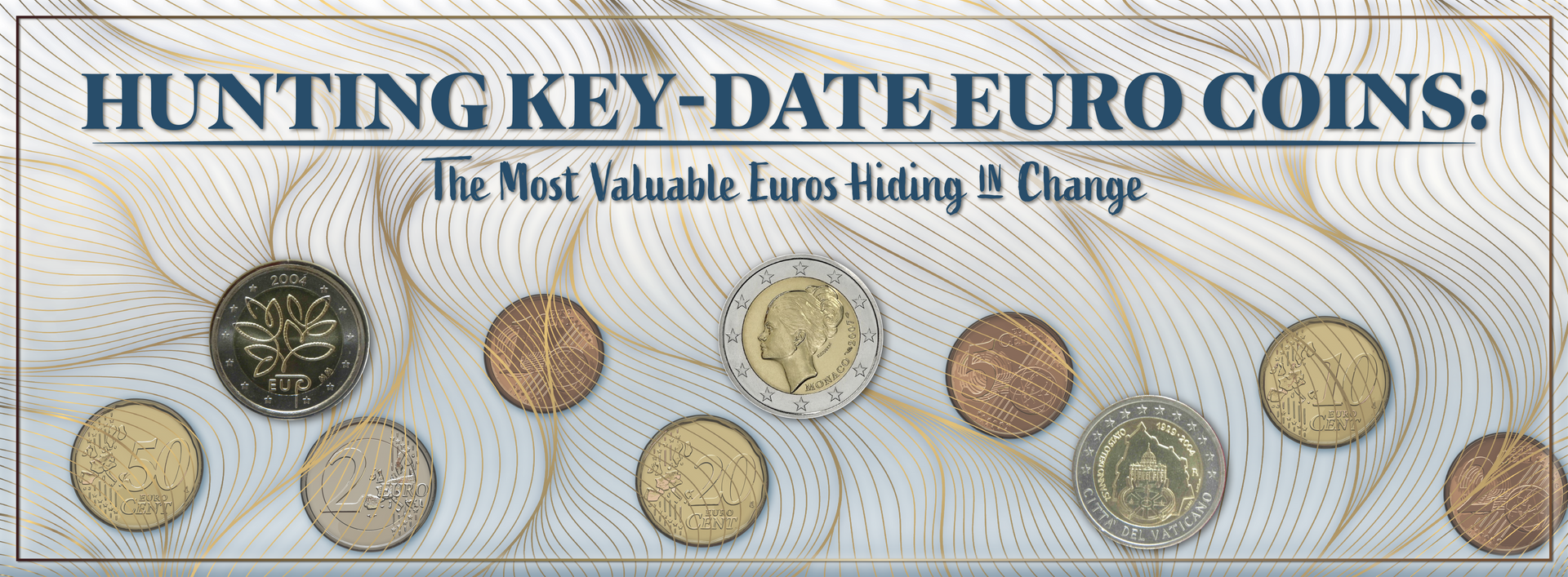
Most people treat Euro coins as interchangeable. Spend them, toss them in a jar, move on.
Collectors know better.
Since the Euro era began, each country has issued its own national side designs—meaning a €2 from one country can be common as gravel, while a €2 from another country (or a specific commemorative) can be something you put in a flip and never spend again. And unlike many “modern rarities,” Euro coins still offer what collectors love most: the chance to find value in the wild.
This isn’t a get-rich-quick game. It’s a treasure hunt—part knowledge, part patience, and part being the person who actually looks at their change.
Why Euro Coins Are Still Worth Searching
Euro coins are one of the few modern systems where collectors can still hunt circulating coins with real upside.
Why?
- Euros are still actively used across multiple countries, so coins travel.
- Value is often driven by mintage and distribution, not age.
- The €2 denomination supports commemorative designs that can end up in everyday commerce.
That last point matters. When a commemorative is released and spent normally, it becomes a scattered needle-in-haystack situation—and that’s where collectors thrive.
Start With the Big Truth: “Rare” Often Means “Small Country”
If you remember one thing about hunting Euros, make it this:
Small issuing country + low mintage + high demand = trouble for your wallet (and opportunity for your collection).
Microstates and small issuers matter because their mintages can be tiny compared to Germany, France, or Italy. Monaco and Vatican City, in particular, have produced some of the most sought-after €2 pieces in the entire series.
The Headliners: Euro Coins Collectors Actually Chase
Below are examples collectors routinely cite as “the ones to know.” Values vary wildly by grade and market timing, so instead of treating numbers as promises, use these as priority targets—the coins you learn first because they’re consistently chased.
Monaco: the heavyweight
- Monaco €2 (2007) “Grace Kelly”
Often described as the most famous/valuable €2 commemorative, largely because the mintage was extremely low and demand is worldwide. - Monaco €2 (2015) “Fortress / Prince’s Palace” (800th anniversary)
Another Monaco low-mintage commemorative that collectors treat as a “blue chip” Euro target.
San Marino: collector-friendly, often limited
- San Marino €2 (2004) “Bartolomeo Borghesi”
A famous early San Marino commemorative that appears on many “most valuable €2” lists and is widely tracked in mainstream price guides.
Vatican City: strong demand, careful sourcing
- Vatican City €2 (2004) “75th Anniversary of Vatican City State” (often cited as a key early Vatican €2)
- Vatican City €2 (2005) “World Youth Day” (also frequently cited by collectors)
Collector reality check: Many microstate/Vatican issues were sold in collector packaging and may not truly circulate often. You can find them, but you’re more likely to encounter them in dealer trays, collections, or mixed lots than in a grocery store transaction.
Top Targets: Microstates + High-Chase €2 Commemoratives
| # | Issuer | Year | €2 Commemorative (What to Look For) | Issuing volume / mintage | Find likelihood in change | Why collectors chase it | Quick notes |
|---|---|---|---|---|---|---|---|
| 1 | Monaco | 2007 | Princess Grace (25th anniversary of death) | 20,000 (European Central Bank) | Near-zero | Most famous trophy €2; extremely low volume | Typically not truly “circulating”; you’ll see it via dealers/lots more than pocket change. |
| 2 | Monaco | 2015 | Foundation of the Fortress / First Castle on the Rock | 10,000 (Royal Dutch Mint) | Near-zero | Ultra-low mintage Monaco issue; blue-chip demand | Often sold as collector product; verify authenticity and packaging claims. |
| 3 | Monaco | 2016 | Monte Carlo (Proof issue) | 15,000 (Royal Dutch Mint) | Near-zero | Another low-mintage Monaco favorite | Proof/collector packaging is common; treat as “buy/find in lots,” not “change hunt.” |
| 4 | Monaco | 2022 | Prince Albert I (100th anniversary / commemorative) | 15,000 (Numismag) | Near-zero | Modern Monaco scarcity + strong collector base | Great “modern trophy” target; avoid overpaying at peak hype. |
| 5 | Vatican City | 2004 | 75th anniversary of Vatican City State | 100,000 (European Central Bank) | Very low | Vatican demand stays strong; early-year Euro commemorative | Often seen in official sets/coincards; change finds are uncommon. |
| 6 | Vatican City | 2005 | World Youth Day (Cologne) | 100,000 (European Central Bank) | Very low | Popular early Vatican issue; consistent collector interest | Frequently traded in packaging; condition matters a lot. |
| 7 | Vatican City | 2007 | 80th birthday of Pope Benedict XVI | 100,000 (European Central Bank) | Very low | Low issuance + Vatican collector base | Look for clean examples; many are set-sourced. |
| 8 | Vatican City | 2013 | Sede Vacante (vacant see) | 125,000 (European Central Bank) | Very low | Distinct theme + limited volume; widely collected | A “story coin” that stays in demand. |
| 9 | San Marino | 2004 | Bartolomeo Borghesi | 110,000 (European Central Bank) | Very low | Key early San Marino €2; strong niche demand | Often appears in collections/lots; still a top target. |
| 10 | San Marino | 2005 | World Year of Physics (Galileo theme) | 130,000 (European Central Bank) | Very low | Popular theme + low issuance | Great example of “serious commemorative” with lasting appeal. |
| 11 | San Marino | 2007 | Giuseppe Garibaldi (bicentenary) | 130,000 (European Central Bank) | Very low | Recognizable historical figure + limited volume | A consistent “set builder” coin. |
| 12 | San Marino | 2014 | Giacomo Puccini (90th anniversary of death) | 100,000 (European Central Bank) | Very low | Music theme + low issuance; collector-friendly | Modern, attractive, and often pursued as part of runs. |
| 13 | Andorra | 2014 | 20 years in the Council of Europe | 100,000 (European Central Bank) | Low | Andorra’s early €2 issues have strong demand | More “possible” than Monaco, but still not a common change find. |
| 14 | Finland | 2004 | EU Enlargement (10 new member states) | 1,000,000 (European Central Bank) | Medium (in Europe) | Scarce enough to matter, and actually huntable | One of the best real “circulation hunt” targets. |
| 15 | Luxembourg | 2007 | Grand Ducal Palace | 1.1 million (European Central Bank) | Medium (in Europe) | Smaller-issuer scarcity + strong set builders | A realistic pocket-change target compared to microstates. |
“Worth Looking For” Doesn’t Always Mean “Worth Thousands”
Not every good Euro find is a Monaco-level trophy. There’s a profitable middle ground: coins that aren’t ultra-rare but are scarcer than people assume and consistently picked out of circulation.
A strong example collectors cite:
- Finland €2 (2004) “EU Enlargement”
This is one of the early commemoratives and is known enough that collectors actively watch for it. It’s the kind of coin that can show up in change and still make you pause and check the date.
The takeaway:
you don’t need to hit a “lottery coin” to make Euro hunting worthwhile. A steady stream of “good pulls” is what keeps collectors engaged.
How to Hunt Euros Like a Collector (Not Like a Tourist)

Learn the “country tells”
Start by training your eye to recognize the national sides for:
- Monaco, San Marino, Vatican City
- Andorra (if you include newer issuers)
- Small countries with distinctive designs
Once you can spot those at a glance, you’ll naturally slow down and examine the date and condition.

Focus on the €2 pile first
If you only have five minutes, check €2 coins before €1 or cents. Why?
- They host commemoratives
- They’re more frequently collected
- They’re more often set aside by casual collectors

Build a travel-change routine
If you (or family) travel:
- Keep a separate pocket/jar for €1 and €2
- Sort by country at home
- Then check dates
This is low-effort and surprisingly productive.

Work dealer “foreign bins” with intention
Some dealers toss modern Euros into generic foreign trays. Others price everything individually. Your best opportunities are:
- Mixed bins that haven’t been cherry-picked
- Shops that don’t specialize in modern Euro varieties
The Three Things That Actually Drive Value
When you’re deciding whether to keep a coin, ask:
- Mintage and distribution: Was it made in small numbers, and did it circulate?
- Demand: Do collectors consistently chase it, or is it a one-season fad?
- Condition: Modern coins live hard lives. Uncirculated pieces tend to command the best premiums.
If you want a simple rule:
Low mintage + high collector demand + clean condition is where the real premiums live.
Common Mistakes (That Cost Collectors Money)
- Buying hype-list prices as “guaranteed values.”
Market prices shift, and condition matters. Use lists for targeting, not promises. - Overpaying for “rare” coins that were only “rare on TikTok.”
If you can’t verify mintage/issue details from a reputable catalog or price guide, slow down. - Ignoring the edge and the details.
Some Euro value comes from subtle differences, inscriptions, or errors—especially in modern issues.
Where Euro Coins Fit in a World Collection
Euro hunting complements bullion collecting beautifully because it adds:
- Discovery
- History-in-progress
- A low-cost entry lane that still rewards expertise
It’s also just fun. There’s something deeply satisfying about pulling a coin from everyday change and realizing: most people would have spent this without looking twice.