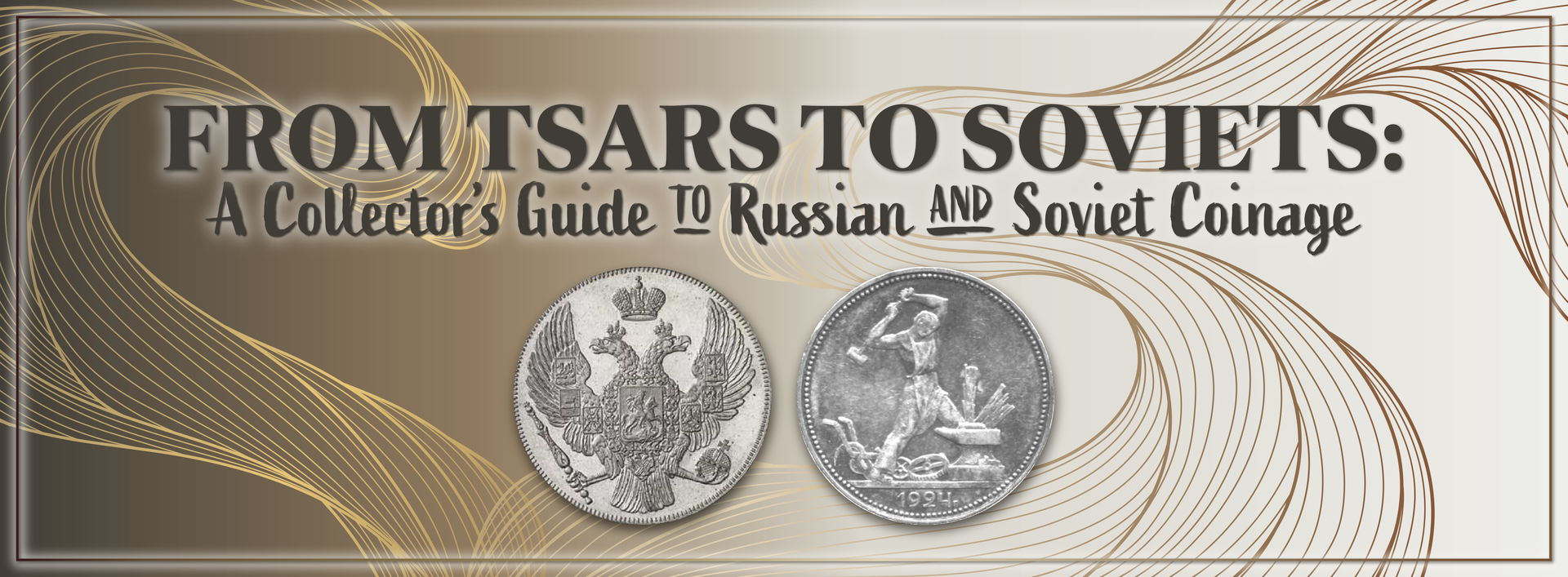
Few coin traditions show transformation as clearly as Russia’s. In one collecting lane, you’ll find Imperial gold and silver struck to project authority and stability. In another, you’ll find Soviet issues built for function—often humble metals, bold symbolism, and mass circulation.
That contrast is exactly why collectors love this area: it’s a long, dramatic story told in small, tangible pieces. The trick is knowing where the real collector demand sits, how to avoid the fakes and fantasy listings, and how to build a set that makes sense without getting lost in the sheer volume of material.
Why Russian and Soviet Coins Attract Serious Collectors
Collectors gravitate here for three reasons:
- Distinct eras you can clearly separate. Imperial and Soviet coinage aren’t subtle variations—they’re different worlds.
- Strong type-collecting potential. You can build a meaningful set without chasing rare dates.
- Active markets for cornerstone coins. Certain “workhorse” types trade constantly and remain liquid, especially in gold.
If you like coins that carry historical weight without requiring a PhD to collect intelligently, Russia is a strong lane.
Imperial Russia: Coinage as Authority
Imperial coins were meant to signal legitimacy—often through portraits, heraldry, and precious metal. The collecting sweet spot for many world-coin buyers is the late Empire, especially Nicholas II issues, because they’re widely collected, well documented, and available in multiple price tiers.
The Imperial gold “core types” collectors start with
5 Roubles (Nicholas II, gold .900):
A popular entry coin because it’s smaller and often easier to buy than larger gold types. NGC documents standard specs (gold .900, ~4.30g, 18mm).
10 Roubles (Nicholas II, gold .900):
The classic “big brother” type. Numismatic references list the 10 roubles as gold .900 and 8.6g, struck 1898–1911.
15 Roubles “Imperial” (1897, gold .900):
Often treated as a prestige type in the series. NGC lists the 15 roubles as gold .900, ~12.90g.
Why these work as “core types”:
- recognizable portrait + imperial eagle reverse
- consistent gold alloy (easy to verify)
- strong collector base
- often available in multiple grades
The Imperial silver lane (a different kind of appeal)
If you want Russian history without jumping straight into gold, Imperial silver is where many collectors land.
A standard Nicholas II 1 rouble type is well documented as silver (.900), 20g, with a large diameter—big enough to feel substantial in hand.
This lane rewards eye appeal: original surfaces, honest wear, no cleaning.
The Soviet Shift: Function Over Form (and Why That’s Collectible)
Soviet coinage is often described as “utilitarian,” but that’s part of its charm. It’s a record of a system that wanted coins to be clear, durable, and widely usable.
Collectors usually break Soviet collecting into two big buckets:
- Early Soviet silver (highly collectible, historically rich)
- Later circulating and commemorative issues (widely available, great type sets)
Early Soviet silver: the “gateway coins” collectors actually keep
A strong starter target is the 50 kopeks (poltinnik) series from the 1920s—real silver, real history, and approachable pricing. NGC documents the 1924 50 kopeks as silver (.900) at roughly 10g.
Numismatic references also note that early silver issues began fading from circulation later in the 1920s, which matters for availability and condition.
These coins are popular because they bridge:
- early revolutionary imagery and symbolism
- traditional silver coin collecting
- enough availability to build sets without constant frustration
The 1961 reform: why Soviet coin “eras” are easy to collect
For later Soviet coins, a key dividing line is the 1961 monetary reform, which redenominated the ruble (10:1) and created the “Sixth rouble” period in the numismatic catalogs.
This helps collectors because it naturally organizes your collecting into eras:
- pre-1961 issues
- 1961–1991 circulating coinage
- commemoratives within those periods
Where Collector Demand Actually Lies
Here’s the honest market reality: not every Russian coin is rare—but certain categories are consistently chased.
Collectors tend to prioritize:
1) Imperial gold in problem-free grades
Common-date 5 and 10 roubles remain popular because they’re easy to understand, widely traded, and easy to liquidate compared to obscure world gold.
2) “One-of-each-era” type sets
Many mature collectors build a type set like this:
- one Imperial gold type (5 or 10 roubles)
- one Imperial silver rouble
- one early Soviet silver (50 kopeks/poltinnik)
- one later Soviet commemorative
It’s historically meaningful without becoming overwhelming.
3) Select Soviet circulating commemoratives
For example, the 1965 1 rouble “Victory” commemorative is a well-documented circulating commemorative type and is widely collected as an affordable, iconic Soviet-era piece.
A Practical “Collector Roadmap” (What to Buy First)
If you want a clean path that avoids regret:
Step 1: Choose your lane
- Bullion-like lane: Imperial gold 5 or 10 roubles (common date)
- History lane: one Imperial silver rouble type
- Soviet lane: a 1920s silver 50 kopeks + one later commemorative
Step 2: Buy one solid example before you chase varieties
Russian coinage has deep variety rabbit holes. Save that for later. Early on, you’re building foundations.
Step 3: Let condition do the talking
In this category, clean, original surfaces beat “rare” coins with problems more often than collectors expect.
Collecting Carefully (This Market Has Traps)
Russian and Soviet coins are absolutely collectible—but this is not a lane where you buy blindly.
The biggest risks to avoid
Counterfeits and altered coins:
High-demand gold and early silver attract fakes. Stick with reputable dealers and consider certified examples for higher-value purchases.
Cleaned coins:
Cleaning is common in older Russian silver. It can seriously reduce collector value. If the coin looks “too shiny for its age,” slow down.
Misleading “rare” claims:
This category is loaded with listings that call common coins rare. Trust catalogs, grading services, and reputable references—never the adjective “rare” in a listing title.
When grading makes sense
For:
- higher-value Imperial gold
- key-date Imperial silver
- high-grade early Soviet silver
Certification can be worth it simply as risk control.
Closing Perspective
Russian and Soviet coinage offers a rare collecting experience: two distinct worlds—Imperial authority and Soviet utility—connected by a single monetary story.
If you’re a world-coin collector who enjoys history you can hold, this is one of the most rewarding lanes to build slowly and intentionally. Start with one strong Imperial type, add one early Soviet silver piece, and let your collection grow into the era that speaks to you most.