
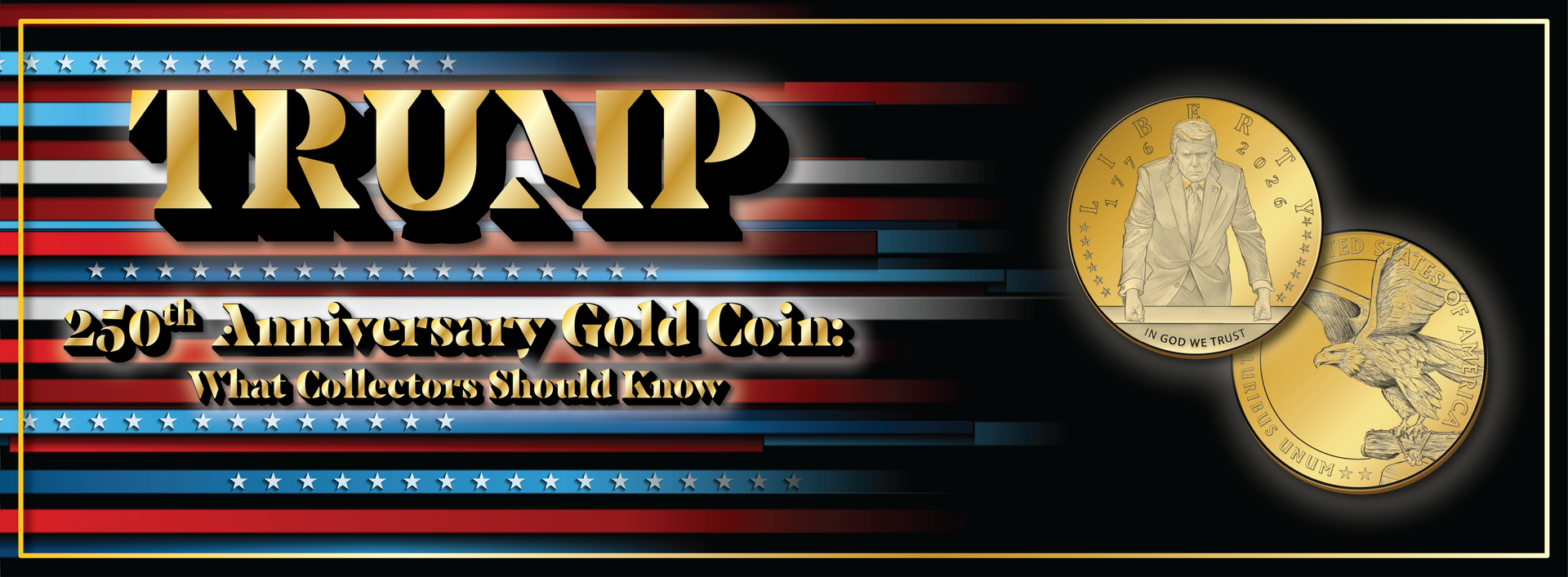
It is not often that a modern U.S. coin story jumps out of hobby circles and into national headlines, but this one has. The U.S. Commission of Fine Arts approved the final design for a 24-karat gold commemorative coin bearing President Donald Trump’s image as part of the 2026 Semiquincentennial celebration. The Associated Press reported that the vote clears a key step for the U.S. Mint, but the coin’s size and denomination are still undecided. The official CFA project record also lists the submission as a final review and links the 24K gold presentation used in the meeting.
For collectors, this matters for more than headlines. The U.S. Mint says the 2026 Semiquincentennial program is a one-year-only anniversary effort with special circulating changes, collector products, and 24k issues tied to America’s 250th birthday. That means this gold coin is not an isolated novelty. It sits inside one of the most closely watched modern Mint programs in years.
What Happened With the Trump Gold Coin?
It’s not often that a modern U.S. coin moves beyond collector circles and into national headlines—but this one has.
The U.S. Commission of Fine Arts (CFA) has formally approved the final design for the 2026 Semiquincentennial 24-karat gold commemorative coin featuring President Donald J. Trump. That designation—marked as a final review—confirms that the design itself has cleared one of the most important steps in the federal approval process.
In practical terms, this is no longer a concept or a proposal. It is now part of the official America 250 coin program pipeline.
At the same time, collectors should recognize what remains unresolved. While the design is approved, the U.S. Mint has not yet confirmed the coin’s denomination, size, mintage, issue price, or release structure. Those details will ultimately determine how this coin behaves in the market.
That contrast—a finalized design paired with unfinished specifications—is exactly what makes this story worth watching.
What Does the Approved Design Show?
The approved design presents a bold, deliberate composition that blends modern portraiture with traditional American symbolism.The design doesn’t try to blend in—and that’s intentional.
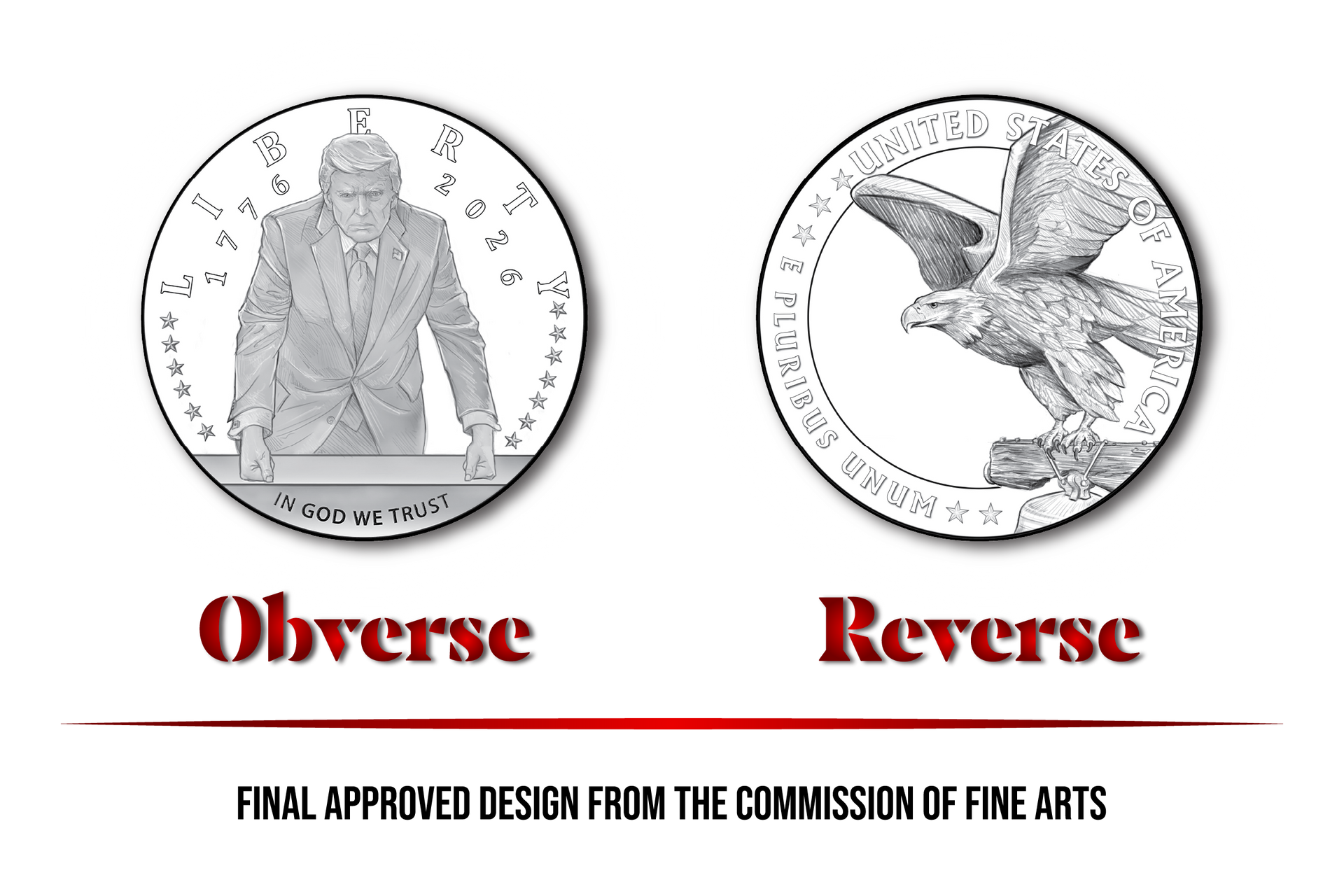
The obverse features President Trump leaning forward beneath LIBERTY, accompanied by the dual date 1776–2026 and the inscription IN GOD WE TRUST. The portrait is based on a formal reference associated with the National Portrait Gallery, giving it a structured and historical tone.
The reverse centers on a bald eagle in flight—an enduring symbol in U.S. coinage that reinforces themes of strength and continuity.
This is not a quiet commemorative design. It is intended to stand out within the Semiquincentennial program, both visually and symbolically.
And whether collectors admire it or question it, one thing is certain:
👉 It will be talked about.
Why This Coin Is Different From a Typical U.S. Release
This coin does not follow the traditional path most modern U.S. commemoratives take.
Rather than moving strictly through standard commemorative frameworks, it is being positioned as a 24-karat gold collector issue under broader Treasury authority. That distinction introduces flexibility in how the coin may ultimately be structured, including its specifications and release format.
It also helps explain why this coin has developed differently from typical Mint products.
Collectors should also separate this issue from the Trump $1 coin proposal, which has been discussed alongside it. The $1 coin designs belong to a separate initiative. The gold coin approved by the CFA is a standalone commemorative tied directly to the America 250 program.
Understanding that distinction is important, because it prevents incorrect assumptions about how this coin will be issued or priced.
Why This Coin Is So Controversial
This is where the conversation moves beyond design—and into something much larger.
At the center of the debate is a long-standing tradition in American coinage: historically, U.S. coins have avoided depicting living individuals, particularly sitting presidents. For generations, that convention has helped shape both collector expectations and the broader identity of U.S. coin design.
That is what makes this coin different.
Featuring a sitting president on a U.S. commemorative gold coin places it outside modern precedent, and for many collectors, that alone is enough to make it one of the most unusual issues in recent memory.
1️⃣ The First Layer: A Living President on U.S. Coinage
The most immediate point of controversy is simple:
👉 This coin would feature a living, sitting president.
While U.S. law does not universally prohibit living individuals from appearing on all coinage, the long-standing practice has been to avoid it—especially with presidents. That tradition has created a sense of neutrality and historical distance in American coin design.
For some collectors and observers, this coin represents a break from that norm.
For others, it represents a moment in time—one tied to a specific presidency and a significant national milestone.
2️⃣ The Second Layer: Process and “Hand-Picked” Leadership
A second area of criticism focuses on how the coin moved through the approval process.
Some critics have pointed to the role of a presidentially influenced or appointed committee structure, suggesting that the approval reflects a process shaped by aligned leadership rather than traditional independence.
That concern has been widely discussed in media coverage and political commentary.
However, it is also important to place that argument in context.
Presidents—across administrations and throughout U.S. history—have consistently appointed individuals who align with their priorities, perspectives, and governing style. That is not unique to this situation; it is part of how the federal system has functioned for generations.
For collectors, this becomes less about politics and more about understanding
how decisions are made, and how those decisions influence coin design outcomes.
👎What Critics Are Saying
Critics tend to focus on two main concerns:
- Breaking precedent by placing a sitting president on U.S. coinage
- Shifting the tone of coin design toward something more contemporary and potentially political
Some lawmakers have gone further, introducing proposals aimed at preventing living or sitting presidents from appearing on U.S. coins altogether.
Within the numismatic community, there are also more practical concerns. Some experienced voices have warned that controversy may generate early attention, but does not always translate into sustained collector demand.
👍What Supporters Are Saying
Supporters frame the coin very differently.
From that perspective, this is:
- A patriotic tribute tied to America’s 250th anniversary
- A reflection of a modern presidency during a historic milestone
- A design meant to capture a specific moment in the nation’s story
There is also an argument that commemorative coins, by their nature, are meant to reflect moments, people, and themes that define a period in time—even when those choices are bold.
The Collector Perspective
For collectors, the most important takeaway is that this debate is not just political—it is also practical.
Coins that generate strong reactions often attract attention. But attention alone does not determine long-term value.
What matters more is how collectors respond over time:
- Does demand remain strong after release?
- Does the coin find a place within established collections?
- Or does interest fade once the headlines move on?
That is the question that ultimately matters most.
Because in the end, collectors are not just reacting to the story.
They are deciding whether the coin belongs in their collection—and whether it will hold its place there.
What Collectors Should Watch Next
At this stage, the design approval is only one part of the story.
The factors that will ultimately determine this coin’s success remain unconfirmed. These include the final denomination, physical size, total mintage, issue price, household order limits, and overall release structure.
Without those details, it is not possible to make reliable projections about premiums or long-term value.
There has been some early discussion suggesting the possibility of a one-ounce coin with a $250 face value. However, those figures have not been officially confirmed and should be treated cautiously until the U.S. Mint publishes final specifications.
Collectors who have been through multiple modern releases understand this pattern well. Early attention can be strong, but long-term performance depends on how supply, demand, and product structure ultimately align.
Final Collector Takeaway
The Trump 24-karat commemorative gold coin is already one of the most widely discussed modern U.S. coin developments in recent years.
It brings together historical timing, a distinctive design, and a level of public attention that extends beyond the traditional numismatic audience. At the same time, it remains an incomplete product from a collector’s perspective.
The most effective approach is a disciplined one.
Focus on the confirmed facts. Watch for the final specifications. Evaluate the coin within the broader America 250 program.
And most importantly, remember...
🪙 Attention creates interest.
🪙 But structure determines value.
TRUMP GOLD COIN FAQ
Is the Trump gold coin officially approved?
The design has been approved at the CFA’s final review stage. That does not mean every product detail is finished, however, because the coin’s size and denomination are still reportedly under discussion.
Is this the same as the Trump $1 coin proposal?
No. The proposed Semiquincentennial $1 coin is a separate initiative. The March 19 approval concerns the 24-karat commemorative gold coin, which is a different product entirely.
Has the face value been announced?
Not officially. Some reporting has referenced a possible $250 face value, but that has not been confirmed for this approved gold coin. Until the U.S. Mint releases final specifications, that figure should be treated as unconfirmed.
Will this coin circulate in everyday pocket change?
No. Current reporting describes it as a non-circulating collector gold coin, not a standard coin intended for everyday use.
Why is the coin controversial?
The controversy comes from both politics and tradition. Supporters see it as a fitting tribute tied to America’s 250th anniversary, while critics argue it breaks long-standing numismatic and democratic norms by placing a sitting president on official U.S. coinage.
What should collectors watch next?
Collectors should watch for the final denomination, diameter, mintage, issue price, household order limits, and release details. Those factors will matter far more to long-term value than the early headlines.
Sources
This article was prepared using official federal records, U.S. Mint materials, major national news coverage, and numismatic industry reporting. Readers who would like to review the underlying materials can explore the following sources:
- U.S. Commission of Fine Arts — Project Record
- U.S. Commission of Fine Arts — March 19, 2026 Meeting Record
- Commission of Fine Arts — Submitted 24K Gold Coin Design Presentation PDF
- U.S. Mint — Semiquincentennial Coins and Medals
- U.S. Mint — SemiQ $1 Coin Candidate Designs
- Associated Press
- Reuters
- The Washington Post
- Fox Business
- TIME
- Coin World
- CoinNews
- Sen. Catherine Cortez Masto Press Release
- Sen. Jeff Merkley Press Release